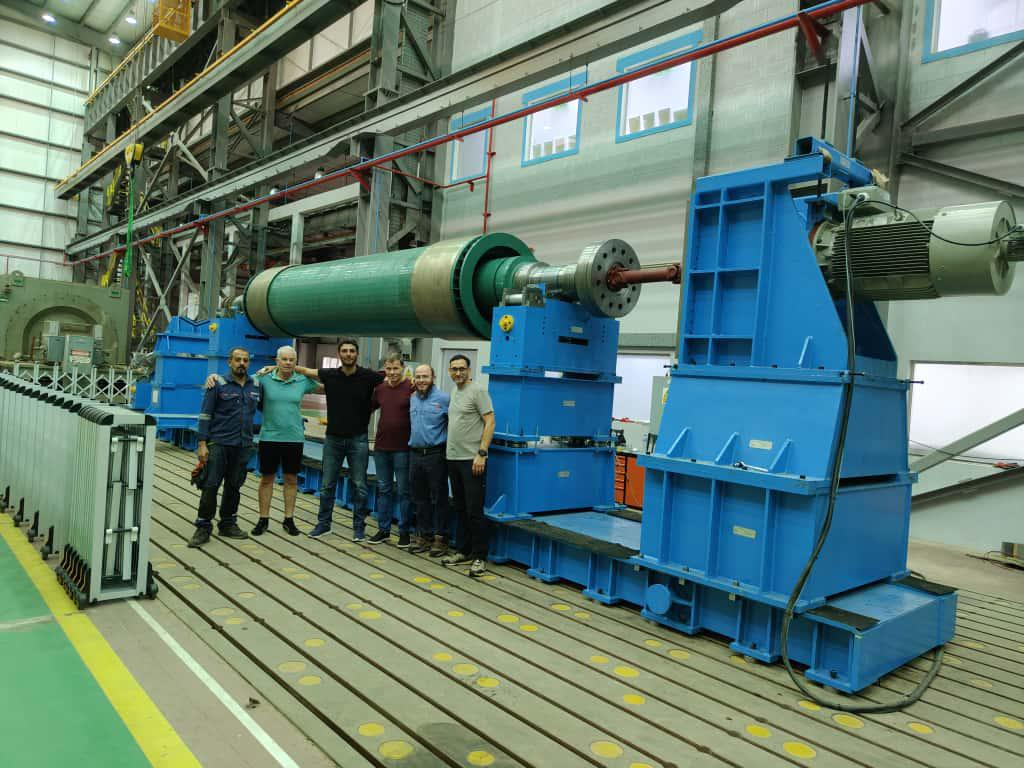
The MB100: Transportable Balancing + Lathe Machine in One System

Designed to reduce downtime and optimize costs through mobility and precision. Balance rotors up to 100 tons and over 4.5m diameter on-site, meeting ISO G 1.0 and EU 2023/1230 standards without depending on a workshop

The Operation We Aim For

The MB100 is a transportable & customizable system that combines rotor machining capabilities and precise low-speed balancing in a single machine, designed and built in compliance with  EU 2023/1230 standards.

Built for your specs – Configure parameters for your exact rotor types and requirements

Machine + balance in one – Lathe and soft-bearing balancing integrated in a single machine.

Take it anywhere – Balance and machine rotors on-site, at any facility or field location, by simply transporting the machine.

Faster,  cost-efficient operations – Shorten schedules and reduce costs with increased operational control.

Reduced transport risk – Keep rotors on-site and avoid logistics, delays, and handling damage.

Grow your capabilities – Balance and machine rotors when you decide with your own engineers and technical team. ↓

The System

Designed and supported by ex-OEM engineers who understand that each client operates under unique technical conditions and budget considerations, we’ve developed a hybrid delivery model that maximizes both cost efficiency and technical excellence.

Our Hybrid Engineering Approach: Flexibility Meets Precision

MB100 transportable Balancing + Lathe Machine.

We build fully integrated, customizable machines delivered ready for operation, including:

Soft-bearing roller system, integrated lathe, drive system, instrumentation, software, and installation support.

Build Your Own Machine (Recommended for Cost Optimization)

We supply the core elements of the balancing system: The critical soft-bearing roller boxes (50-ton or 100-ton capacity), balancing hardware, and software. We support your engineering team in fabricating the remaining structure locally.e model requirements.

Our Engineering Solution

Simultaneous Access to All Balance Planes

Ideal balancing weights distribution

Flexible Torque-RPM Configuration

Alternate between high torque-low RPM for machining and low torque-high RPM for balancing. Each machine is customized to your specific rotor requirements.

Runout Measurement + Mechanical Fitness Correlation

Identify bow, unbalance, or local deformations in the same setup. Know if your shaft is fit for operation before reassembly.

Zero Transportation Risk

Your rotor never leaves the plant. Eliminate shipping damage, insurance costs, and logistical delays.

  • The rotor never leaves the plant, and all work can be performed on site at the customer’s premises.
  • Transportation risks and costs are eliminated, removing the need to send the rotor to specialized balancing workshops.
  • Balancing can be performed in parallel with other maintenance activities, meaning it is no longer on the critical path of the maintenance program.
  • Allows achieving high balance quality in compliance with ISO G1.0 Levels, API, DVI, and MIL-STD-167-1 standards.
  • Enables runout measurement along the entire rotor axis and correlation with the balance condition, identifying mechanical issues such as bending, unbalance, or local deformations.
  • Provides simultaneous access to all balancing planes, allowing weight placement in areas not accessible when the machine is in service.
  • Improves balance quality by allowing the distribution of correction weights across multiple planes.
  • Allows the consolidation of existing balance weights, freeing field balancing planes and simplifying future balancing during operation.
  • Light machining operations can be performed directly on the balancing machine.

Live it: Discover how the Machine would look on Your Site

Experience the MB100 at true scale, in your own environment, through our 1:1 Augmented Reality model.
This isn’t a render — it’s presence. See how the system fits within your space, and receive a custom interpretation of what it could mean for your operation.

Is soft-bearing technology right for your Operation?:

The soft-bearing system suspends the rotor on flexible supports. The rotor behaves as if “floating,” allowing the system to measure its natural motion directly.

Balancing is performed at frequencies above the suspension’s resonance point, offering key advantages:

You can balance rotors at much lower and safer speeds, unlike rigid systems that require high speeds to generate sufficient detectable force.

You don’t require a massive, rigid foundation. You only need a level surface that supports the combined weight of the rotor and machine. This dramatically reduces installation costs.

You can move the equipment without affecting its calibration, unlike hard-bearing machines that require recalibration after each relocation. This is critical for multi-site operations.

 A single system can handle an expanded range of rotors simply by changing suspensions and rollers, without needing multiple machines or complex configurations.

Each rotor is balanced using the trial weight method, meaning the system self-calibrates for each specific rotor, guaranteeing precision regardless of variations.

The gimbal design allows rollers to rotate and automatically align with the rotor, minimizing journal damage. Rigid systems use crowned rollers that concentrate pressure and can damage surfaces over time.

Although rotors with extreme initial unbalance may require additional techniques (such as static balancing or pedestal locking), the system is designed to handle these situations from the ground up.

Ensuring traceable, verifiable balancing accuracy at every step.

The system can be deployed nearly anywhere, with flexible work supports providing natural isolation from nearby activity.

One machine handles diverse applications without major reconfiguration.

 This technology has been validated through decades of industrial use and adopted by multiple OEMs for both fixed and transportable applications. Our operational track record demonstrates a 100% success rate in achieving residual unbalance values within ISO G1.0 tolerances across diverse rotor types (contact us to learn more about ISO G1.0).

Expand Your Balancing Capacity