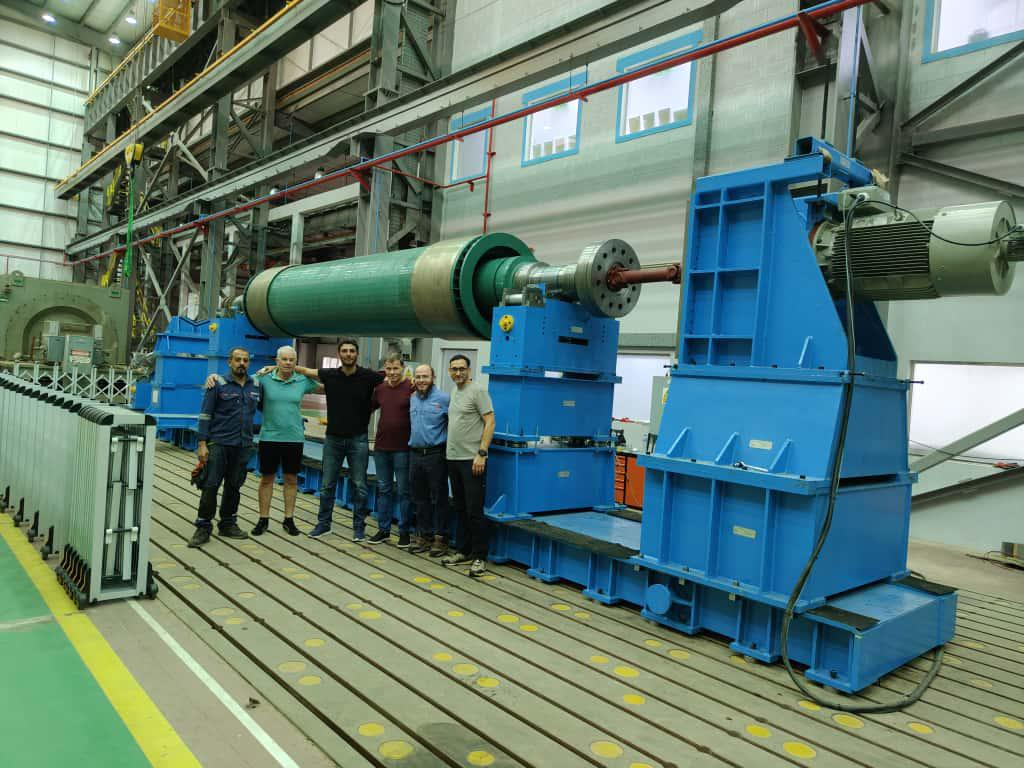
The MB100: Transportable Balancing + Machining in One System

Designed to reduce downtime and optimize costs through mobility. Balance rotors up to 100 tons and 4.5m diameter on-site, meeting ISO G 1.0 and EU 2023/1230 standards without external dependencies.

The Operation We Aim For

The MB100 is a transportable & customisable system that combines precision rotor machining and soft-bearing low-speed balancing in a single setup. Install fixtures, perform precision machining, then switch to balancing mode —all documented to EU 2023/1230 standards. This reduces logistics complexity, eliminates transport exposure & costs, and gives you direct control over the process. 

Our collaboration with your engineering team achieves the following:

Take it anywhere – Balance rotors on-site, at any facility or field location.

Built for your specs – Configure parameters for your exact rotor types and requirements.

Machine + balance in one – Lathe and soft-bearing balancing integrated in a single setup.

Faster,  cost-efficient operations – Shorten schedules and reduce costs with a unified workflow.

Control your timeline – Balance when you decide, not when workshops are available.

Zero transport risk – Keep rotors on-site and avoid logistics, delays, and handling damage.

The System

Designed and supported by ex-OEM engineers (Ansaldo/Alstom/Toshiba) who understand that each client operates under unique engineering constraints and budget considerations, we’ve developed a hybrid delivery model that maximizes both cost efficiency and technical excellence.

Our Hybrid Engineering Approach: Flexibility Meets Precision

Complete MB100 transportable Balancing + Lathe Machine.

A fully integrated, customizable machine delivered ready for operation, including:

Soft-bearing roller system, integrated lathe, drive system, instrumentation, software, and installation support.

Balancing can be performed in parallel to other activities and removed from the maintenance program’s critical path, while achieving balance levels aligned with ISO, API, DVI, and MIL-STD-167-1, enabling runout measurement along the rotor axis to assess mechanical condition and detect issues such as bending, unbalance, or local deformations, and providing simultaneous access to all balancing planes, allowing the placement of weights even in locations not accessible when the machine is in service.

Hybrid Engineering Partnership (Recommended for Cost Optimization)

We supply the core elements of the balancing system: The critical soft-bearing roller boxes (50-ton or 100-ton capacity), balancing hardware, and software. We support your engineering team in fabricating the remaining structure locally.

We provide comprehensive engineering support: Detailed consulting, complete design drawings, technical specifications, integration guidelines, and ongoing technical collaboration to enable your team to locally source and fabricate the remaining components—such as the lathe bed structure, pedestals, drive components, and auxiliary systems.

This model reduces CAPEX while maintaining complete technical integrity. Your team gains deep operational knowledge, and the final configuration adapts to your facility or service model requirements.

Our Engineering Solution:

• The rotor remains on site, avoiding off-plant handling.
• Eliminates transportation risks and costs to external workshops.
• Balancing runs in parallel with other maintenance tasks.
• Achieves balance levels per ISO, API, DVI, MIL-STD-167-1.
• Measures runout and identifies shaft issues (bending, unbalance, deformation).
• Provides access to all balancing planes, even hard-to-reach areas.
• Improves balance quality with multi-plane weight distribution.
Consolidates existing weights, freeing field balancing planes.
• Allows light machining directly on the balancing machine.
• Adapts to existing infrastructure through a full engineering assessment of motors, gearboxes, pedestals, and facility constraints.
• Performs runout and mechanical diagnostics in one setup, improving speed and precision.
• Enables integration of engineered refurbished components when beneficial, delivering rapid, reliable, and cost-efficient solutions.

What's Included

1–3 days maximum with commissioning included. No prolonged disruption to your operations.

• Core soft-bearing roller system (50–100 ton) with full balancing hardware, software, and vibration measurement.
• Engineering package: design drawings, integration guidelines, drive sizing, interface specs, and speed requirements.
• Installation and training: commissioning support plus hands-on balancing of your own rotors.

FAT with full spec verification, guaranteed approval, and compliance with EU 2023/1230 and ISO G1.0.

Continuous support from ex-OEM engineers, enabling low-speed balancing, seal machining, blading, and operation across turbine, generator, compressor, and similar rotors.

Live it: Discover how the Machine would look on Your Site

Experience the MB100 at true scale, in your own environment, through our 1:1 Augmented Reality model.
This isn’t a render — it’s presence. See how the system fits within your space, and receive a custom interpretation of what it could mean for your operation.

All we need are a few details. Just enough to shape a view that’s not generic — but yours.

This is only our 3d model, to visualise the MB100 in AR, please request access above*

Why soft-bearing technology is superior for your operation:

The soft-bearing system suspends the rotor on flexible supports. The rotor behaves as if “floating,” allowing the system to measure its natural motion directly.

Balancing is performed at frequencies above the suspension’s resonance point, offering key advantages:

You can balance rotors at much lower and safer speeds, unlike rigid systems that require high speeds to generate sufficient detectable force.

You don’t require a massive, rigid foundation. You only need a level surface that supports the combined weight of the rotor and machine. This dramatically reduces installation costs.

You can move the equipment without affecting its calibration, unlike hard-bearing machines that require recalibration after each relocation. This is critical for multi-site operations.

 A single system can handle an expanded range of rotors simply by changing suspensions and rollers, without needing multiple machines or complex configurations.

Each rotor is balanced using the trial weight method, meaning the system self-calibrates for each specific rotor, guaranteeing precision regardless of variations.

The gimbal design allows rollers to rotate and automatically align with the rotor, minimizing journal damage. Rigid systems use crowned rollers that concentrate pressure and can damage surfaces over time.

Although rotors with extreme initial unbalance may require additional techniques (such as static balancing or pedestal locking), the system is designed to handle these situations from the ground up.

Ensuring traceable, verifiable balancing accuracy at every step.

The system can be deployed nearly anywhere, with flexible work supports providing natural isolation from nearby activity.

One machine handles diverse applications without major reconfiguration.

This technology has been validated through decades of industrial use and adopted by multiple OEMs for both fixed and transportable applications. Our operational track record demonstrates a 100% success rate in achieving residual unbalance values within ISO G1.0 tolerances across diverse rotor types (learn more about ISO G1.0 bellow).

Simultaneous Access to All Balance Planes

No need to rotate or reposition. Faster corrections, fewer iterations.

Flexible Torque-RPM Configuration

Alternate between high torque-low RPM and low torque-high RPM. Each machine is customized to your specific rotor requirements.

Runout Measurement + Mechanical Fitness Correlation

Identify bow, unbalance, or local deformations in the same setup. Know if your shaft is fit for operation before reassembly.

Zero Transportation Risk

Your rotor never leaves the plant. Eliminate shipping damage, insurance costs, and logistical delays.

Technical Capabilities

Maximum rotor weight

100 tons

Maximum rotor diameter

4,500 mm

Operating speed

100–250 rpm (recommended)

Balancing standard

ISO G 1.0

Motor power

66 kW

Torque output

Up to 25,000 Nm

Compliance

EU 2023/1230, ISO, API, DVI, MIL-STD-167-1

Machining capabilities

Grinding, polishing, light lathe work

How It Works: From Validation to Operation

Submit technical documentation. We validate compatibility in <48h at no cost.

Get a detailed technical and commercial proposal tailored to your needs. If you are opting for our hybrid solution, you will fully understand how the integration will work.

Confirm your order and secure your position in the manufacturing queue (lead time ≤9 months, shorter for the hybrid solution).

Witness factory acceptance tests. Machine ships upon your approval.

Our engineers install the MB100 in 1–3 days and train your team by balancing 3 rotors together on-site.

FAQ

Most frequent questions and answers

That’s why we offer a free technical evaluation first. Send us your rotor specs, and we’ll confirm compatibility in <48h with no commitment. We’d rather be honest up front than promise the impossible. On top of that, our machine is customizable, in part due to modularity (which also makes it significantly easier to transport), ensuring that it meets 100% of your requirements.

We balance 3 of your rotors with your team on-site during installation. Most teams are operationally independent within the first week. We provide ongoing support until full mastery because we believe in working side by side with maintenance and engineering teams, to bring clarity and expertise to every job.

The machine is designed for field reliability. We provide maintenance protocols, spare parts availability, and remote technical support from ex-OEM engineers.

Balancing grades are ISO-defined levels that determine how much residual unbalance a rotor can carry at its operating speed. Lower grades such as G1.0 require very tight tolerances and minimal vibration, while grades like G2.5 allow more unbalance and are sufficient for general industrial equipment. For power-generation turbines—particularly steam turbines—the ability to achieve ISO G1 is relevant because these machines operate at high speeds, with large masses and tight mechanical clearances. Precise balance reduces vibration, protects bearings, prevents mechanical fatigue, and maintains operational efficiency. In practical terms, G1 capability ensures reliability, longer turbine life, and stable power output, which are essential performance and safety requirements in generation environments.

If you already operate a lathe, you are significantly closer to a viable balancing capability than most teams assume. A lathe provides a strong structural foundation, and with a focused engineering assessment of your motor, gearbox, and pedestal interfaces, we can determine whether your existing drive train can support the low-speed, high-torque requirements of balancing. In many cases, the available equipment is already suitable; where it is not, the adaptations tend to be direct and cost-efficient.

Once drive feasibility is confirmed, our soft-bearing balancing modules—roller boxes, instrumentation, electronics, and control software—can be integrated with controlled, predictable modifications. This transforms the lathe environment into a functional balancing platform without requiring major reconstruction or specialized foundations.

In practical terms, having a lathe places you well along the path toward a complete balancing solution. The integration effort is typically far simpler than expected, and the result is a system capable of handling large rotors, executing diagnostics, and achieving the precision associated with modern soft-bearing technology.

Expand Your Balancing Capacity

We will contact you to collect your rotor data. Within 48 hours you receive a no-commitment technical validation. If approved, you may reserve a fabrication slot and receive a full technical-commercial proposal.